Kidney coverage and support
Dialysis takes your time. Paperwork should not.
Plainly reads the notices and tracks the coverage. Every step lives in one place. The social worker sees the day. The person in the chair owns the record.
Say it once. It is written.
One queue. Four lines.
Free to read. Always.
After the visit
Say the note out loud.
Step into the hall and talk for about thirty seconds. Plainly sorts your own words into a draft note. You read it, fix what is wrong, and sign it.
- Your voice only.
- Nothing is filed until you sign it.
Plainly never records the patient. It records you, and only when you press record.
Four spoken lines turn into a draft note under one section heading. The note ends up signed by the social worker.
Monday morning
Four lines, and the rest of the day back.
Every open thing you carry sits on one of four lines. The lines empty as the work gets done, and the queue says how many people need nothing from you today.
You carry more people than one week has hours for. Plainly does not add a number to that. It sorts it.
Due this week and Past due empty out. Waiting on outside groups does not move, because an outside group answers on its own clock. Needs you keeps one cell lit, so the queue never reaches zero.
Three kinds of paper. One record.
Coverage, money, and paper chases all sit on the same record, right next to the notes.
Insurance
Ask the coverage question in writing. The answer comes back dated, with its source named.
Bills
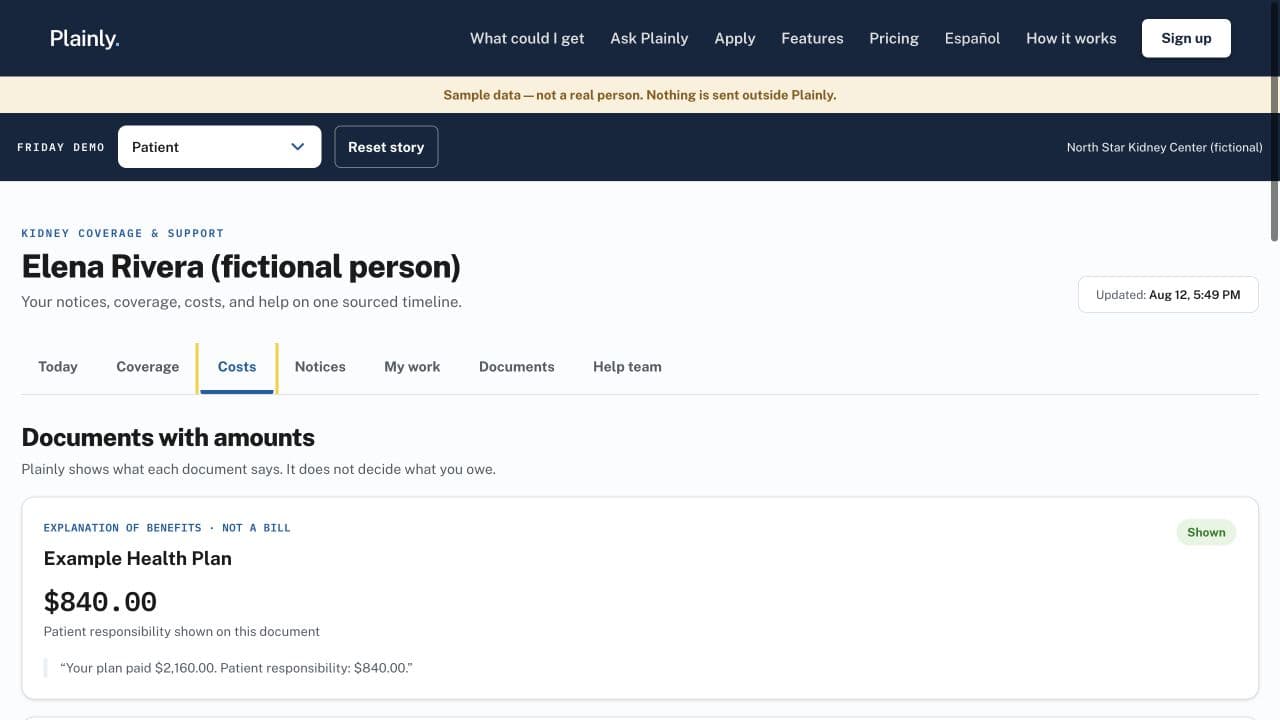
Plainly sets the plan notice beside the bill and shows the difference.
Records and signatures
Each request keeps dated steps and one named owner, so nothing dies at step three.
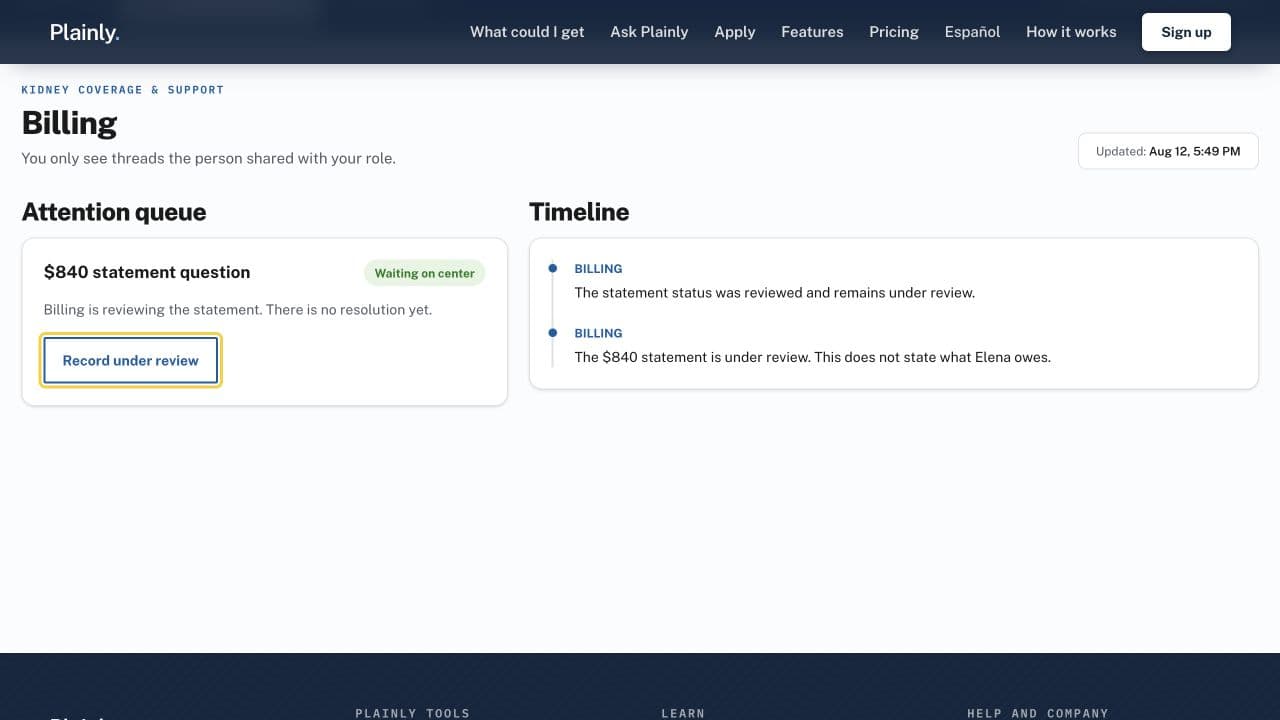
Two papers cover the same treatment. The dates match. The amounts do not, so Plainly states the difference and logs one question for billing. Neither paper is called the right one.
What you promised becomes a task.
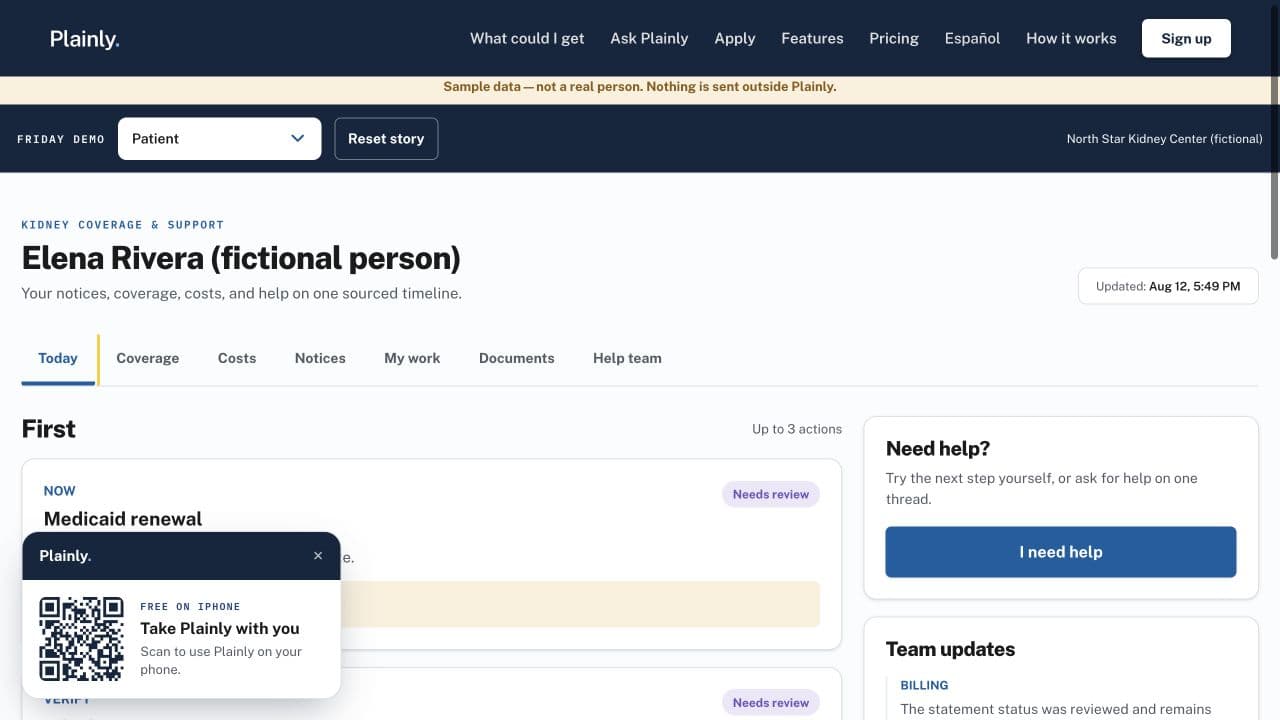
When you say you will do something, Plainly lifts that sentence out and makes it a task with your name on it.
The sentence stays attached to the task, so nobody has to guess what it meant.
I will call the ride company Thursday and get her standing pickup fixed.
Call the ride company about the standing pickup
You · Thursday
The real screens.
Eighteen silent seconds inside the workspace, then three stills from it. Sample data throughout.
From the printed rules
Who pays first, and when that changes.
Medicare for kidney failure runs on a clock. Plainly works that clock out from the printed rules and shows the exact words it used.
42 CFR 406.13(e)(2)
“Entitlement begins on the first day of the third month after the month in which the individual initiates a regular course of renal dialysis, if the course is maintained throughout the waiting period, unless entitlement would begin earlier under paragraph (e) (3) or (4) of this section. This means that if dialysis began in January, entitlement would begin April 1.”
Office of the Federal Register (eCFR) · Stored copy retrieved August 13, 2026
Medicare.gov, End-Stage Renal Disease (ESRD)
“This coordination period lasts for 30 months.”
Centers for Medicare & Medicaid Services (Medicare.gov) · Stored copy retrieved August 13, 2026
Medicare.gov, End-Stage Renal Disease (ESRD)
“Once you become eligible for Medicare because of permanent kidney failure, there will still be a period of time, called a “coordination period,” when your employer or union group health plan will continue to pay your health care bills.”
Centers for Medicare & Medicaid Services (Medicare.gov) · Stored copy retrieved August 13, 2026
Medicare.gov, End-Stage Renal Disease (ESRD)
“At the end of the 30-month coordination period, Medicare will pay first for all Medicare-covered services.”
Centers for Medicare & Medicaid Services (Medicare.gov) · Stored copy retrieved August 13, 2026
These are stored copies of published rules, quoted word for word. Plainly never decides coverage. The agency or plan decides.
What Plainly never does
- Plainly never decides coverage. The agency, plan, or SSA decides.
- Plainly never gives medical advice. Clinical decisions stay with your care team.
- Plainly never submits for you. You always press the last button.
Your letters and your coverage stay free to read. Forever. For everyone.
Start where you are.
I work at a dialysis center
Your center sets up the account. Sign in and the queue is waiting.
Sign inI get dialysis
Set up your own space in about two minutes.
Set up my spaceHave a code from your center? Use a code
My center is not on Plainly yet
Adding a person takes one text or a center code. Center leaders can read how the program works and talk to a human.
Center leadership: how the program worksTalk to a person
Tell us what a good first month would look like at your center. We will say plainly whether Plainly can do that.
Tell us what success looks like. We agree on it, then we start.
A person reads every message the same day.